Tuesday, February 21, 2006

Forgetting to Remember


Psalm 137:1-6 (New Living Translation)

“Beside the rivers of Babylon, we sat and wept as we thought of Jerusalem.
We put away our lyres, hanging them on the branches of the willow trees.
For there our captors demanded a song of us. Our tormentors requested a joyful hymn: “Sing us one of those songs of Zion!”
But how can we sing the songs of the LORD while in a foreign land?
If I forget you, O Jerusalem, let my right hand forget its skill upon the harp.
May my tongue stick to the roof of my mouth if I fail to remember you.


Winters seem longer to me now than when I was young. Back then I used to hope they’d never end, but nowadays they seem almost eternal.

Here in Kansas it’s been a very unusual winter. We’ve had long periods of record warmth and few storms, punctuated by short bursts of bitter Artic cold and wind. Most days seem to hold the promise of spring and the sight of life once again bursting forth. But, occasionally, too occasionally, winter forces its reality back on us. It doesn’t want to let go. It’s at those times that spring, with all its promise, seems so distant.

For the past month or so I’ve been spending a good part of my mornings at the recreation center here in town. From about eight-thirty till eleven I walk about four miles on an indoor track, then ride a stationary recumbent bike for about ten, and finish it all of by pumping a bit of iron. It’s become a routine in keeping with winter. One of the saving graces in it all is that there are a lot of other folks doing the same thing I’m doing. Most of them are grey panthers like me. There are a few younger folks, but not many. Another saving grace in this routine for me is that I’m able to do two, sometimes three laps to the one most of my companions are able to negotiate. It all makes me feel like the big fish in the small pond.

Why am I doing this? Nancy has said she wants to keep me around for a while. That’s a really good reason. I want to stay around for a while too. She’s grown on me as much as I’ve grown on her.

One of the things that struck me this week was that the effort must look down right silly or amusing to someone on the outside looking in. I’ve never seen the spectacle from that vantage point, but I imagine we must look like a formation of single-file gerbils or hamsters going around in circles as we make our rounds on the track. I do occasionally glance at the others pedaling along with me on the three recumbent bikes adjacent to the track and I chuckle every time I do. We’re pedaling as fast as we can, but we’re going nowhere. The miles pile up on the odometers, but we never move an inch. It’s akin to watching Greek mythology played out on the Kansas Flint Hills. Like Sisyphus, we’re sweating, straining, huffing, puffing, and going nowhere. It’s a very amusing spectacle indeed.

As I was making my rounds this morning a few questions occurred to me. They came at about my thirtieth lap, when the routine was becoming very, very routine. “Don’t you have something better to do with your time?” “What on earth is this all about?” Do you even remember why you’re here?” It seemed that a new question would come with each lap of the track. Then, at about lap thirty-five I broke through the wall, so to speak. I’ve never run a marathon before, but I’m told that all good runners hit a wall sometime during their run. It’s the place where the whole endeavor makes no sense whatsoever, where the mind seems to be telling the body, “Stop, you idiot. I’m not going to let you go a step further.” Once that wall is reached it takes an act of will to overcome it. That’s the only thing that works. I passed over my wall at about lap forty. As I did I had an epiphany. I remembered why I was doing what I was doing. I remembered that I was doing all of this so that Nancy could have the pleasure of my company for years to come. I felt a rush of adrenalin course upward through my body as I did.

The lesson that I can’t afford to lose in this winter of routines is clear. I’m doing these things for a reason. I need to remember not to forget that or I really will wind up just walking aimlessly around in circles.

After reading the news this morning I felt that the politicians in Washington, D.C. need to remember that lesson too.

We seem to have entered into some sort of national winter. The political climate in America these days is decidedly mixed. We’re hoping on one hand that winter will soon be over and that a spring of national and international hope is going to be re-born in a month or so. While that’s going on, though, we also seem to have forgotten how this winter descended upon us. We’ve forgotten to remember. We’re so caught up in our routines that we’re just spinning our wheels. For some of us the routine is “Hate George Bush.” For some it’s political opportunism. For some it’s finding the Pulitzer Prize story. For some it’s just forgetting about the mess we’re in. For some it’s taking advantage of the mess we’re in. We’ve settled into our routines, in much the same way the grey panthers and I do as we make our way around the recreation center track.

No one seems to be immune. Just a few days ago the Bush administration gave us a clear demonstration of just how much we’ve forgotten since this national winter set in. Six of our most vital seaports, which are already extremely vulnerable, have been sold to a company in the United Arab Emirates. The administration is trying to put the best possible spin on the deal. Michael Chertoff, our Homeland Security Secretary, is telling us that the deal has been reviewed. Upon reading the Secretary’s words of comfort I wondered exactly what he meant by saying the deal “has been reviewed,” so I did some checking. I went straight to the horse’s mouth, the Committee on Foreign Investment in the United States. According to this group of wizards their task is to determine whether or not the sale of a U.S. interest to a foreign corporation or entity is safe. Apparently they felt that the sale of six U.S. ports to a corporation in the United Arab Emirates met our current national security requirements. What did they consider?

“The Exon-Florio provision lists the following factors that the President or his designee may consider in determining the effects of a foreign acquisition on national security. These factors are:
(1) domestic production needed for projected national defense requirements;
(2) the capability and capacity of domestic industries to meet national defense requirements, including the availability of human resources, products, technology, materials, and other supplies and services;
(3) the control of domestic industries and commercial activity by foreign citizens as it affects the capability and capacity of the U.S. to meet the requirements of national security;
(4) the potential effects of the transaction on the sales of military goods, equipment, or technology to a country that supports terrorism or proliferates missile technology or chemical and biological weapons; and
(5) the potential effects of the transaction on U.S. technological leadership in areas affecting U.S. national security.”

How long did it take them to reach the conclusion that this sale was good for our national security? Thirty to forty-five days, or ninety days at most!

Brilliant! Absolutely brilliant! We’re in the middle of a national winter and the Bush administration is ready to sell our security to the highest bidder. And, what’s worse, the President is now vowing to veto any attempt by the Congress to block the deal.

We’ve really lost our way. We’ve forgotten what this is all about. Even the President, who told the terrorists who brought down the Twin Towers of the World Trade Center that they’d be hearing from all of us, seems to have given in. It makes me wonder whether or not some sort of political Alzheimer’s has descended on our nation’s capitol. When George Bush seems to have forgotten what this is all about we’re in big trouble.

I realize that the attack took place over four years ago. That’s a long time. But, we’ve got a problem. While we seem to be forgetting, the terrorists aren’t. They want to kill us by the millions:

“One of Osama bin Laden's press mouthpieces, Sulaiman Abu Ghaith, has announced that al-Qaeda aspires “to kill 4 million Americans, including 1 million children,” in response to casualties purportedly inflicted on Muslims by the United States and Israel.”

One of the best possible ways to do this would be to nuclear device of some sort. How would a terrorist get it here? By ship:

“The easiest way to bring a nuclear weapon into the United States is probably in a cargo container by sea.”

So, we have terrorists chomping at the bit to kill millions of us and the President and his administration want to sell some of our most vulnerable ports to the highest bidder. He and his administration seem to have forgotten to remember. We’ve forgotten that we’re in this thing for the long haul. God help us!

Technorati tags for this post:

George Bush

September 11th

Friday, February 17, 2006

Escapism of the Highest Order


Ezra 3:10-13 (New Living Translation)

10”When the builders completed the foundation of the LORD's Temple, the priests put on their robes and took their places to blow their trumpets. And the Levites, descendants of Asaph, clashed their cymbals to praise the LORD, just as King David had prescribed. 11With praise and thanks, they sang this song to the LORD:
“He is so good! His faithful love for Israel endures forever!”
Then all the people gave a great shout, praising the LORD because the foundation of the LORD's Temple had been laid.
12Many of the older priests, Levites, and other leaders remembered the first Temple, and they wept aloud when they saw the new Temple's foundation. The others, however, were shouting for joy. 13The joyful shouting and weeping mingled together in a loud commotion that could be heard far in the distance.”


For the past week or so I haven’t watched the news, read the newspaper, or blogged. I’ve apparently missed the really important things going on while I was trying to take a break from all the madness. I’ve been back in the real world since yesterday and I’ve found out that Dick Cheney accidentally shot a hunting partner last Saturday and failed to notify the Washington press corps in a timely manner. It was a sin of the gravest order. It was big news, about as big as it gets. David Gregory was outraged. Hillary Clinton was miffed. And, Dick Morris and a chorus of left wingers accused Cheney of being drunk when the accident occurred.

While that was going on, Saddam was cavorting around a Baghdad courtroom in his pajamas, protesting his inhumane treatment. He’s even embarked on a hunger strike to let the world know of his plight. I suspect it won’t be long before the press is drawing comparisons between Saddam and Mahatma Gandhi. An ocean away, Zacharias Mousawi spent a day or so trying to shout down the court where his trial is being held. Give it a bit more time and the pro-Zacharias pickets will be forming outside the courthouse. I can even seem them in my mind’s eye – “Free Zacharias” – “End the Unjust Imprisonment of Terrorists.” It’ll be grist for the media mill. Who knows? He could wind up being their next cause celebre.

Here in Emporia the big news hasn’t caught hold yet. I’m sure it will in time. I have no doubt that right now Patrick Kelley is absolutely salivating over all the important things going on in the world beyond exit 130. He’s just trying to find some way to make it all a bit more palatable for the less enlightened here in town. Once he finds the language suitable for us rubes we’ll find out.

Last night I opened the Wednesday and Thursday editions of the Gazette and found out that the really big news in Emporia has been land use. One of the city engineers bought a considerable amount of acreage a while ago, and now he wants to parcel it out into smaller lots, to be sold, I assume, to the highest bidder. It seems innocent enough. But, one of the facts that Brandy Nance, the Gazette’s intrepid cub reporter, missed in the story was that the landowner was also the city’s zoning administrator. An interesting fact that Brandy, to her credit, did get right was that one of the commissioners considering the landowner’s request, couldn’t, wouldn’t, or was prevented from voting because of his “personal involvement” in the project. A vote was taken and the landowner’s request was denied.

On the surface it seemed like a small victory for the people. I guess that should have been the end of the story, but to a rube like me this has a bit of the smell of nepotism and conflict of interest to it. While I can’t say for sure, it does look and smell fishy. I realize that I’m a bit unpracticed at these sorts of things. I’ve only taken a few journalism classes in my life, but I think that if I were part of the Gazette’s team I’d be snooping around city hall to see if there might be a dead fish or two or ten the good folks running the city could be trying to hide from the rest of us. As I said, though, I’m unpracticed in these matters. While I’d be inclined to snoop, though, the Gazette is inclined to tout. In their editorial opinion published the same day, they seemed quite sympathetic to the landowner’s plight:

“With abundant open spaces as far as the eye can see, one would think that developing housing developments would not be a challenge. Unfortunately, that is not the case.”

It’s hard to argue with the logic. I’m as much a capitalist as the owners of the Gazette.

Well, to put the lid on the jar, yesterday Emporians were treated to even more news. The city’s budget shortfall, which a few months ago was “only” $450,000, has now ballooned to $700,000. The original shortfall was explained as some sort of administrative error. The quarter of a million heaped on seem to defy explanation. According to the Gazette’s story, it’s either a matter of bad projections, lack of oversight, or Topeka’s failure to provide more state aid.

My rube nature tells me that reason number two bears some looking in to. There’s money being lost. There’s money floating around and there’s a lack of oversight. For a rube like me it raises questions. Is the best that can be said about this is that we’re being governed by incompetents? Or is there more to the story? I don’t know, but this sure seems like time for good journalist to do some digging. The Gazette, however, seems unconcerned. As Scott Rochat noted:

“That does not mean the city is bankrupt. Money from the water and sewer funds has been transferred over to cover the difference, something the city has done frequently.”

Whew! Emporia has escaped a crisis. That’s swell! It appears that the city can just keep shuffling money around to make up for the mysterious disappearance of hundreds of thousands of dollars. That’s what I call real world government. I’m absolutely overjoyed!

Knowing that we can keep shuffling money around to keep the wolf away from the door, I suppose I should feel better about the situation. It’s just the reality of small town life. In a week or so, Patrick Kelley will be picking up on really important stories, like hunting accidents in Texas, and this will all be forgotten about until next year when another seven or eight hundred thousand bucks comes up missing.

I spent a few minutes this morning digging through one of my old journalism texts to see if there was something useful I could glean about Emporia’s current state of affairs from it. There, on page six, I found this nugget:

“In a number of small towns today the local editors deliberately follow a comfortable, “don’t rock the boat” policy in covering hometown news. They thus avoid antagonizing advertisers and officials and keep the profit margins sound. But they also neglect their chief reason for being: informing the people fully and honestly.”

Here in Emporia, in practical terms, it means that we’ll continue to read more about hunting accidents in Texas than we will about conflicts of interest, nepotism, or missing funds. Why antagonize the city commissioners, zoning administrators, or other city officials when the Vice President or some other far away government bureaucrat is such a convenient target? All we rubes here in Emporia need to do is to allow this network to continue operating as it has for years. Why look more closely at the problems when a tax increase, a shift in funds, or a Patrick Kelley editorial about some national figure seems to make them miraculously vanish?

With all of this going on I decided the current stories and priorities being jammed down my throat weren’t to my liking. It became clear to me that a bit of escapism was in order. I realize that even thinking so makes me a bad citizen. I should be concerned with what’s going on around me. But, like many rubes in these parts I find that escape in my religion is far more profitable than reading the newspaper or watching the news on television. Thus, on Wednesday Nancy and I made our escape up to Lawrence, Kansas, to see the Soweto Gospel Choir perform at the Lied Center.

In case you haven’t heard of them, the following brief biographical sketch should give you some idea of who they are:

“The Soweto Gospel Choir was formed to celebrate the unique and inspirational power of African Gospel music. The 26-strong choir, under the direction of David Mulovhedzi and Beverly Bryer, draws on the best talent from many churches around Soweto. The choir is dedicated to sharing the joy of faith through music with audiences around the world.”

Soweto, the home city of the choir, is also the cradle of the movement that overthrew the apartheid system in South Africa. There, in the nation of their birth, their homeland, blacks were segregated and oppressed in cruel fashion. They were forced, by law, to live in “homelands,” a euphemism that meant blacks lived in homes without plumbing or electricity, in a culture that deemed that one tenth of the money spent to educate white children was more than enough for the children of blacks, and had their South African citizenship revoked and replaced with citizenship in a “black homeland.” Anyone who attempted to cross the legally imposed limits was dealt with ruthlessly.
The under-reported reality of life in South Africa back then was horrible.

It took generations for things to change. It was an epic struggle of good versus evil. It was filled with travail and pain. But, it was so much more. It was a struggle won by the power of a people’s faith. Journalists and politicians didn’t fix the problem. People exercising faith did. In the end, because of a people’s faith, right triumphed and the evil of apartheid was dismantled.

For two hours Wednesday night I saw the source of the people of Soweto’s power. It was their faith in God. It was very evident and very alive in their music and dance. As I listened and watched I could sense the pain born of years of abandonment and oppression, but I could also feel the joy and sense of triumph fill the auditorium. Faith had moved the mountain of apartheid and the Soweto Gospel Choir's message was clear, filled with the joy of a people who have overcome.
It was a great lesson for me to re-learn. Faith is the most powerful instrument of change in the world. It can move mountains and it can dismantle unjust systems. South Africa is living proof of that fact.

What does this have to do with American national politics, the American press, and events here in Emporia, Kansas? Everything! Call it escapism if you will, but there are a lot of us who’ve built our lives on a promise far more important than any politician or journalist could ever offer us. So often, in this time when oppression in one form or another seems to be the rule, we’ve found that faith is the only thing that makes life meaningful or sensible.

For those who make the rules, rule the airwaves, or rule the local newsrooms the life of faith must seem like a futile attempt to escape the realities of the world. They’d like to believe they’re the movers and shakers, the instruments of power and change in the world. They’d like to believe that as they move and shake we should blindly follow, living as if our lot in life is to place our faith and affection in them.

It would be nice if in some small way we could. Society works better in an atmosphere where trust prevails. But, what we rubes have found, based on bitter experience, is that when we set our affections and hopes in the wrong things our faith is misplaced. If we were to blindly follow the world’s lead we’d wind up in the ditch with them. Nothing would really change for the better. Life would consist of nothing more than following blind guides, as Jesus said it would be.

The state of affairs in Washington, D.C. and Emporia, Kansas serve to illustrate the point the Master was making. The real truth is that rightly placed faith is the only thing that can really move mountains or shake institutions. The Soweto Gospel Choir is proof of that. The politicians, journalists, and power brokers would like to think they can, but they can’t. All they have to offer is more and more of the same old things we’ve grown so weary of. It’s a world in which paper is shuffled around from copy desk to copy desk in the same way the city fathers shift money from account to account.

What I find really fascinating about this is that those who don’t follow the lead of the self-anointed among us are branded as either escapists or religious fundamentalists. Well, if we are escaping anything it’s the clutches of those who cling to the illusion that the world revolves around them.
So, for us rubes this is really a matter of trying to escape the insanity all around us. I say, given the reality I see all around me, that it's escapism as it should be.

Techonrati tags for this post:

Apartheid

Dick Cheney

Emporia, Kansas

Journalism

Soweto

Friday, February 10, 2006

Valentine's Day

Proverbs 25:25 (King James Version)

“As cold waters to a thirsty soul, so is good news from a far country.”


I couldn’t find the newspaper this morning. The carrier usually throws it to the north, about a half block away from our house. Today, however, he added a new wrinkle to our on-going dance. After spending a good ten minutes trying not to look like a prowler stalking the houses around Tenth and Neosho, I gave up and went back inside the house. Nancy, who’d just gotten up and was anxious to read all the goins’ on, asked me if the paper had come. “If it has,” I said, “I can’t find it. I think the carrier has found a creative way for me to get some useless exercise.”

I was content to start the morning without the news, but Nancy wasn’t. So, she decided to make her own search of the neighborhood. About three minutes later she came back in, today’s issue of the Kansas City Star in tow. The carrier, who’d gotten even more creative than I’d imagined, threw it to the south, dark print up, at the end of our driveway.

We settled in. I read the sports section first; Nancy did the main pages. I followed the sports with the entertainment news; Nancy did the metropolitan and editorial section. We completed the morning ritual by trading the metropolitan and the entertainment sections with one another.

I felt quite vindicated in the end. The newspaper, as is almost always the case, wasn’t really worth the trip. Getting caught up on the latest muggings, hearings, terrorist bombings, riots, murders, rapes, pandemics, editorial opinions, licentious affairs, or legislative recriminations is not the ideal way to start a day. Yet, we continue to do it, along with millions and millions of our fellow Americans. It’s become a habit we can’t seem to break.

At about 8:30, Nancy took the newspaper upstairs and ran it through the shredder. Ginger, a stray cat we found about a month ago outside our local ice-cream parlor, was spayed and de-clawed yesterday. The shredded newsprint is going to be used in her litter box. It’s much softer and cheaper than the scented stuff one buys in the stores these days. It’ll also be gentle our her paws.

At about 10:30 we brought Ginger home from the veterinarian. Twenty minutes later she deposited her seal of approval in the litter box. The newspaper does have some useful purpose after all. Ginger’s happy, and the deposit made is a perfect symbol for how I feel about the state of journalism and the world these days.

Isn’t there something good going on out there? To read our newspapers or watch our media you’d be inclined to think not. It’s all a damned mess.

In the midst of all this madness Nancy and I are celebrating Valentine’s Day early this year. Her mother is having cataract surgery early next week and she’ll be in Kansas City with her while I stay here to take care of things on the home front. So, a few hours from now we’ll be eating tenderloin, Crème Brule, sipping wine and thinking back through our twenty years together, somewhat like I did semi-poetically on Valentine’s Day a few years ago:

Friday, February 14, 5:00 A.M. – I get up as quietly as I can and go out to the pickup truck to get the card and the gift. I shuffle through some old newspapers and dig them out. I go inside, make the morning coffee and plant the card and the gift next to the coffee pot. The gift is a piece of Czech crystal. I’m hoping it will bring Nancy memories of a trip we made to the Czech Republic a few years ago. In my mind’s eye I visualize Nancy reminiscing about dinners served at Milos O’Partney’s Inn. She’s sitting, dreamily, a fire warming her, Arnie the St. Bernard at her feet guarding her, and Milos and his wife serving exquisite food and wine and even more exquisite hospitality. The front of the card has a calico cat snuggling up to a golden retriever who seems to be basking in the glow of the attention he’s getting. The inside of the card reads, “Some relationships just can’t be explained.” As I pour my first cup of morning coffee I think, “Yeah, that’s us for sure.”

Friday, February 14, 5:22 A.M. – I have some time to sit, read, and think. I read
Jeremiah’s words – “They dress the wound of my people as though it were not serious. Peace, peace, they say, and there shall be no peace.” I then stop and consider the theme carried by three of Israel’s prophets who alternately tell us to “Beat swords into plowshares and then, paradoxically, tell us to “Beat plowshares into swords.” I gaze across the coffee table. Book titles gaze back at me – The Two Faces of IslamThe Threatening StormWhy We FightMaking PatriotsPeace Like a River.

Friday, February 14, 6:30 A.M. – I can’t resist the temptation and go upstairs hoping to make just enough noise to wake Nancy without being too obvious. By the time I get to the top of the stairs I see that she’s already awake. I go back downstairs and wait. In a few minutes I hear the shuffling of her feet and then hear the words that have become so familiar to me over the years – “A gift for me? Oh, Philly, it’s beautiful…Thank you.”

Friday, February 14, 6:40 A.M. – Nancy sits, coffee in hand, in her wingback chair. I gaze at her. I smile and tell her “I love you.” She smiles back. “I love you too.” I try to think of something more profound to say but wisely give up. I sense that there’s something far deeper going on inside of me to be captured in words. I decide to just sit and gaze at her, hoping she’ll know what’s going on inside of me. She gazes back. I somehow sense that same something going on inside of her. It’s also too profound to express in words. We sit silently, accepting the moment for what it is. There are no “sweet nothings.” There’s only a morning silence pregnant with unspoken sonnets flowing between us.

Friday, February 14, 6:55 A.M. – Nancy breaks the silence. “You know, I’m really wondering about the trip to Ireland right now. I mean, it’s probably nothing. It’s not that I’m afraid. I think it’s just the times. I’m sure everything would be okay, but I’m not sure we could enjoy the trip with all that’s lingering in the air right now.” I listen and gather my thoughts. There really is something in the air. It’s not anthrax. It’s not VX. It’s just…something. I think ahead a few weeks. The unthinkable has now become thinkable. We’re going to be getting on a jetliner in Chicago bound for Dublin. Thoughts seemingly dredged up from some pit now race through my mind. “Thousands of gallons of fuel.” “A tempting target.” I pause. The thought of being eulogized by Peter Jennings, Chris Matthews, and Aaron Brown now becomes more than I can bear. The thought of Sean Penn and Susan Sarandon pleading for “Peace, peace,” as my DNA is being splattered all over the Sears Tower brings me to the brink of the abyss. I try to put a brave face on my thoughts. “Let’s give it a few days before we decide.” I think it’s my way of comprimising with the current reality.

Friday, February 14, 7:15 A.M. – It’s Valentine’s Day. Love is in the air. But, I know somehow there is more. It’s all wound up together on this special day. The deep, profound love that I have for Nancy is also bound together like the Gordian Knot with other things in the air. It’s a beautiful evening meal in Prague. It’s tea at Beuley’s in Dublin. It’s September 11, 2001 in New Mexico. It’s Osama. It’s Saddam. It’s the “Orange Alert.” It’s all wound up together. I’m told that the German theologians have two terms for expressing history, one expresses the facts and dates, the other expresses what they view as the unseen hand driving history to “some” conclusion. They’re not sure what that conclusion is and that, of course, is what makes German theology German theology. Nothing, as they see is either firm or certain. They call the two schools “history” and “high history.” As I sit and cast another gaze at the one I love I can almost see two rivers colliding. One, as the poet has said, is filled with “Armies on the march and evil reports.” The other is filled with unread sonnets and gazes cast from heart to heart and eye to eye, expressing love too deep for words.

Friday, February 14 – 8:05 A.M. – I leave for work, my daily pilgrimage south through the Kansas Flint Hills to Wichita. As I ease on to the Kansas Turnpike I reflect once again on all that’s in the air. It’s Valentine’s Day in the shadow of September 11, Osama, and Saddam. I turn the radio on to 89.7, National Public Radio. A sultry New Age voice is now reminding me that I’ve also got to worry about Kim. I turn, momentarily, my eyes straining as they try to focus to the east across the highway, hoping to see something that will drown out the added burden brought so seductively to me. I search the horizon and wonder what the day will bring as I begin to see clouds gathering in the east. Anthrax? VX? I plead to Heaven. “You’ve promised You’d split the eastern sky. It’s all twisted, Lord. It’s all twisted. The pretty people, the beautiful people, the people with the straight teeth and the crooked smiles seem to be ruling the day now and they’re calling good evil and evil good. Maranatha…Maranatha.”

Friday, February 14, 8:38 A.M. – I turn the radio off. It’s Valentine’s Day, February 14, 2003. As I move south along the highway I think of all that’s in the air. I think of love. I think of war. I think of sonnets drifting slowly across the Flint Hills. I think of menacing words hissing across the airwaves. I think once more of love. It’s Valentine’s Day and I sense deeply that the air is…..full.

I think one has to dig a lot deeper to find the good news. It’s a matter of faith. A couple of days ago Nancy read something to me from Frederick Buechner’s “Listening to Your Life” that struck a deep chord in me. Buechner was recalling something a professor named James Muilenburg once said that had a powerful impact on his life:

“Every morning when you wake up,” he used to say, “Before you reaffirm your faith in the majesty of a loving God, before you say I believe for another day, read the Daily News with its record of the latest crimes and tragedies of mankind and see if you can honestly say it again.”

Well, I’ve read the news of the day and I find myself re-affirming the truth my faith proclaims. The time is coming when the good news will be separated from the bad, in the same way sheep will be separated from goats. The time is coming when all international disputes will be settled. The time is coming when peace will reign, a time when the endless wars will cease. The time is coming when justice will truly prevail.

Behold, I am coming soon,” Holy Writ declares. That message, so often overpowered by the news of the day, is the good news that’s missing in all the insanity that so often seems to rule our world.

Sometime later this afternoon I’ll be reading the Friday edition of the Emporia Gazette. I don’t think there’ll be a lot of good news there either. It’ll be my afternoon test of faith, I guess.

Buechner’s professor’s question is as relevant to our time as it was to his. Can you still believe after reading the newspaper? I’ve taken the question to heart. I’ve read the news of the day and I still believe. I believe, as the multitudes who’ve gone before me believe that the good will overcome the bad, that wrong will be made right, that justice and truth will be vindicated. I believe that the day is coming when only good news will fill the airwaves :

Revelation 22:1-3 (New Living Translation)

“1 And the angel showed me a pure river with the water of life, clear as crystal, flowing from the throne of God and of the Lamb, 2coursing down the center of the main street. On each side of the river grew a tree of life, bearing twelve crops of fruit, with a fresh crop each month. The leaves were used for medicine to heal the nations.
3No longer will anything be cursed. For the throne of God and of the Lamb will be there, and his servants will worship him.”

Technorati tags for this post

The second coming of Christ

The Kansas City Star

Valentine’s Day

Tuesday, February 07, 2006

Retribution or Distribution


Amos 5:24 (New International Version)

“But let justice roll on like a river,
Righteousness like a never-failing stream!”

I received an interesting comment from Dr. John about yesterday’s post:

“Hamas didn’t get elected because of their virulent hatred of Israel.”

“The Palestinians have lived under an incredibly corrupt regime for all of the time the PA has been in charge. The West has been incredibly generous with assistance to the PA, which the leadership stole, hid, used as bribery fodder.”

“In the destitute neighborhoods of Gaza and the West Bank, the PA cannot deliver so much as the most rudimentary services. Hamas stepped in and filled that void. Potable water, prenatal care for expectant mothers, education facilities, even trash removal. The Palestinian population, of course, is backing those who can deliver on what they promise – like a lot of us, they are fed up with corruption and are now ready to back any alternative to the status quo. In the case of Hamas, they are backing an organization that they have see is able to deliver the goods.”

There’s some truth in that. There’s no doubt that corruption played a role in the election. But there’s a larger truth here. Hamas has a charter, and the blueprint of what they intend to do is there. As I said yesterday, it’s unambiguous. This is a political party with murderous intent and Israel and the Jewish people are the targets:

“So what is left for Hamas and all Muslims to do? Despite Hamas’ pro-forma statement that “humane” Hamas will tolerate Jews and Christians only under the impossible condition that they live under Islamic fundamentalist domination (Article 31), the genocidal logic of Hamas' foundational document is explicit: “Hamas has been looking forward to [implementing] Allah’s promise whatever time it might take. The prophet, prayer and peace be upon him, said: The time will not come until Muslims will fight the Jews (and kill them); until the Jews hide behind rocks and trees, which will cry: O Muslim! there is a Jew hiding behind me, come on and kill him! This will not apply to the Gharqad, which is a Jewish tree.” (Article 7)

While I have no doubt that there is a great need for reform within the Palestinian political movement, I cannot in good faith let it cloud my judgment and assume that Hamas’s political victory will translate into good will toward the Jewish people. In truth, the overriding dream of Hamas, the landslide winners of the Palestinian elections, is the destruction of the state of Israel and death to any Jew, anywhere. That’s what was voted into office.

I learned this much from working closely for two years with a professional associate from Palestine. No one in our organization was sure how things would work for us when he was assigned to my team. Some thought putting a devout Muslim and a devout Christian together was like mixing oil with water. But, they were wrong. We found over our time together that we had a lot in common. We both had strong a strong work ethic. We both shared a deep desire to do our very best every day. There wasn’t even a hint of professional jealousy in our relationship.

Even when it came to matters of religion we found areas of agreement. We came to see that while our theology diverged, our humanity converged. While we often debated, usually over lunch, we never let the differences fracture the good relationship we’d established.

Even though there were things we could share in common, though, we found a significant gap in our discourse. There were a lot of things I could reason with him about, but when the subject was Israel, the Jewish people, and the right of the state of Israel to live peacefully within its borders, things changed. He could never bring himself to accept a two state solution. We could agree that there was a pressing need for reform within the Palestinian political movement. We could agree that the international community, including the United States, needed to support the right of the Palestinian people to establish a state within the family of nations. I even found myself in lock step with him when others expressed dismay at his “clinging to a few acres of dirt.” I knew that he, like many of my Jewish friends, hold that this land is special. I knew that both lay claim to it as a Divine gift. I never saw it as a trivial matter.

We could never agree, however, on the subject of Israel and the Jewish people. His view, which he said was held by the overwhelming majority of Palestinians, was that Israel had to be driven to the sea and that the Jewish people should to be wiped from the face of the earth.

Does the rhetoric sound familiar?

I would plead with him, trying my best to let him know that I believed that God had given promises to two of Abraham’s sons:

Genesis 17:19-21 (New Living Translation)

“19But God replied, “Sarah, your wife, will bear you a son. You will name him Isaac, and I will confirm my everlasting covenant with him and his descendants. 20As for Ishmael, I will bless him also, just as you have asked. I will cause him to multiply and become a great nation. Twelve princes will be among his descendants. 21But my covenant is with Isaac, who will be born to you and Sarah about this time next year.”

But nothing I said, or could say, would change his mind or heart. There was no room for compromise. The nation of Israel and the Jewish people had to be exterminated.

Two sons. Two destinies intertwined. The Biblical view leaves room for both sons to be blessed. Unfortunately, Muslim theology rejects this as fabrication and replaces the Biblical account with Ishmael being the object of the sacrifice, and consequently the blessing of God (Surah 37:101-107).

This is the point of great division. This is the root of the problem. What began with two sons and two promises has become the source of the bitterness, hatred, and bloodshed we see on an almost daily basis. Two people who should be living together in harmony cannot find any path to peaceful co-existence. It’s a tragedy of epic proportions.

In my lifetime, I’ve seen the attempts to find a peaceful solution. And, I’ve seen them all fail. No accord seems to work. Each roadmap offered seems to be nothing more than paper filled with roads leading nowhere.

Nowadays, the fashionable answer is to blame Israel and the Jewish people for the problem. I cannot accept that view. While I’m realistic enough to know that Israel is not a utopian state, I’m also wise enough to know that the Palestinian people want more than reform. They want Israel destroyed. That’s one of the things they voted for. Hamas may be seem to be deferring that plan right now, but the 1988 charter is still in force

This has been clear for generations now. In 1937, for example:

“The Peel Commission recommended a partition plan by which to resolve what it characterized as an “irrepressible conflict…between two national communities with the narrow bounds of one small country. Because of the general hostility and hatred of the Jews by the Muslims, “national assimilation between Arabs and Jews is…ruled out.” Nor could the Jews be expected to accept Muslim rule over them, especially since the grand mufti made it clear that most of the Jews would be transferred out of Palestine if the Muslims gained complete control. The Peel Commission concluded that partition was the only just solution.”

A plan was offered, and:

“The Jews reluctantly accepted the Peel partition plan, while the Arabs categorically rejected it, demanding that all of Palestine be placed under Arab control and that most of the Jewish population of Palestine be “transferred” out of the country because “this country (cannot) assimilate the Jews now in the country.”

That’s the sad reality we’re still living with. Should it be the reality? Of course not! But, when the political aim of one people is the destruction of another, reason and brotherhood cannot prevail.

Despite this seemingly hopeless situation, I know we must keep trying to find a way to reclaim the promise made to two brothers of a homeland, a destiny, and peace. I dream of a day when the people of Israel will see:

“The plowman shall overtake the reaper, and the treader of grapes him that soweth seed; and the mountains shall drop sweet wine, and all the hills shall melt.
14And I will bring again the captivity of my people of Israel, and they shall build the waste cities, and inhabit them; and they shall plant vineyards, and drink the wine thereof; they shall also make gardens, and eat the fruit of them.
15And I will plant them upon their land, and they shall no more be pulled up out of their land which I have given them, saith the LORD thy God.”


And, I also dream of a day when the people of Palestine will find peace, justice, and reconciliation. As it is written:

“But those who believe and work righteousness will be admitted to gardens beneath which rivers flow, to dwell therein for ever with the leave of their Lord. Their greeting therein will be: “Peace!” (Surah 14:23)

I believe that the promise of peace and good will is there for both heirs of God’s promise to embrace. But, it cannot be grasped by one until it accepts the viability of that promise for the other. To that end, Hamas, the Palestinian people, and the Arab world must work toward accepting Israel and the Jewish people as neighbors in this great garden of promise. This vision of distributive justice must supplant the retributive justice now being fostered. Until that happens, there will be no peace.

Technorati tags for this post:
Hamas

Monday, February 06, 2006

Implosion and Explosion


James 1:27 (New Living Translation)

“Pure and lasting religion in the sight of God our Father means that we must care for orphans and widows in their troubles, and refuse to let the world corrupt us.”

One side of the world seems to be imploding, the other is exploding.

Here in the United States we’re at each others’ throats, politically, religiously, and socially. Democrats hate Republicans; Republicans hate Democrats. Liberals hate conservatives; conservatives hate liberals. Darwinists hate creationists and vice versa. Ideological hatred just seems to be the rule of the American day. It’s become as American as mom’s apple pie.

This all has me longing for the time, not so long ago, when this country wasn’t so fractured. In 1980 Ronald Reagan was elected President. The country was in a deep recession and Jimmy Carter, the man I’d supported four years earlier, had become like a ship without a rudder. While he was a decent man, he was not, in my view, a leader. Hence, when the election came I voted for a Republican presidential candidate for the first time in my life.

I think, more than anything else, I was looking for a change in tone. There was much in Ronald Reagan that I disliked, but I did admire his leadership ability. Whatever Jimmy Carter wasn’t in those terms, Reagan was. Many of us felt that way. We were called Reagan Democrats, and we helped give him an election landslide.

It was such a different time. In 1981, when Reagan nearly lost his life to an assassin’s bullet, the nation rallied around him. I’m not so sure the nation would respond that way today. We’re fractured, as columnist David Broder noted a week or so ago:

“The stench of partisanship is so strong in Washington these days that it is difficult to remember that it was not always the case that Republicans and Democrats were at each other's throats. But, in truth, there was a time when friendship and simple human compassion were far more powerful than any political differences.”

We’re imploding, like one of those twenty year old Las Vegas hotels being destroyed for the public good. In Vegas it's called progress. I’m not sure what we’re calling what’s now happening to the nation.

It couldn’t be happening at a worse time. While we’re imploding, the Middle-East is exploding. Hamas, which is dedicated to the proposition that Israel and the Jewish people must be destroyed, just won a momentous political victory in Palestine.

Many in the western press tried to claim that Hamas had renounced its intention to destroy Israel, but Hamas would have none of it. Their 1988 charter, they said, is as valid today as it was when it was first published. That charter outlined, in unambiguous language, Hamas’s aims:

“Israel will exist and will continue to exist until Islam will obliterate it, just as it obliterated others before it" (The Martyr, Imam Hassan al-Banna, of blessed memory)”

For those hoping and praying for a peaceful solution to the Israel/Palestine question, article thirteen of the charter is also clear:

“There is no solution for the Palestinian question except through Jihad. Initiatives, proposals and international conferences are all a waste of time and vain endeavors.”

The election sent a clear message – the Palestinian desire to destroy Israel is not supported by just a few on the lunatic fringe. The fact is, the Palestinian people knew what Hamas was all about before the election and they voted them into office. It was their way of telling the international community that the destruction of Israel is a truly popular movement.

In December, Iranian president Mahmoud Ahmadinejad followed up on his October statement that Israel should be wiped from the map with this shot across the diplomatic bow:

“They have invented a myth that Jews were massacred and place this above God, religions and the prophets,” Ahmadinejad said in a speech to thousands of people in the Iranian city of Zahedan, according to a report on Wednesday from Islamic Republic of Iran Broadcasting.”

“The West has given more significance to the myth of the genocide of the Jews, even more significant than God, religion, and the prophets,” he said. “(It) deals very severely with those who deny this myth but does not do anything to those who deny God, religion, and the prophet.”


In recent weeks, Ahmadinejad has begun to rattle the nuclear saber. Iran is now engaged in a massive attempt to build nuclear weapons. Some analysts say this could become a reality for the world to deal with in less than two years.

Some comfort themselves with the notion that there is time to deal with this crisis. They’re creating a false sense of comfort for themselves. Iranian intentions, under its current leadership, are every bit as clear as is Hamas’s intent to kill every Jew:

“We must prepare ourselves to rule the world and the only way to do that is to put forth views on the basis of the Expectation of the Return,” Ahmadinejad said. “If we work on the basis of the Expectation of the Return (of the Mahdi), all the affairs of our nation will be streamlined and the administration of the country will become easier.”

If all that weren’t bad enough, we’re now being treated to Muslim outrage over the publication of cartoon images of the prophet Muhammad in Danish, French, and German newspapers. Yesterday, the Danish embassy in Beirut was set ablaze by thousands of Muslim demonstrators. While some Muslim leaders are appealing for calm, many are doing their very best to pour rhetorical gasoline on the flames:

“Speaking from Beirut, Omar Bakri Mohammad, leader of the Islamist group Al-Muhajiroon which is banned in Britain, called for those who blaspheme against the prophet to be executed.”
“In Islam, God said, and the messenger Mohammad said, whoever insults a prophet, he must be punished and executed,” he told BBC radio by telephone.”

It’s very ominous and very clear. The Middle East is not Mr.Rogers’ neighborhood. It’s a very dangerous place, exploding daily in acts of violence and hatred.

While we in the west might think of these things as nothing more than the depraved acts of a few lunatics dispersed in a sea of moderation, these recent events carry a powerful message. The lunatics have taken over the asylum. Moderation is not prevailing.

We should have learned that much from the attacks of September 11. The radicals had an agenda in mind then:

“The improbable agenda of the Islamic radicals who perpetrated the 9/11 attacks was to restore the imperial caliphate of Islam and spread its empire across the globe. In the eyes of the terrorist vanguard, America was the “Great Satan” that embodied worldly evil”

For many years I’ve labored under the assumption that the evil being played out on the world stage was being driven by a small number of fanatics. It’s a luxury I can no longer afford. The evil of radical Islam and the danger it poses to the world is much bigger than I’ve been told or imagined. It is a mass movement.

How did it come to this? Historian Bernard Lewis described the causes of the evolution this way:

“It was bad enough for Muslims to feel weak and poor after centuries of being rich and strong, to lose the leadership they had come to regard as their right, and to be reduced to the role of followers of the West. The twentieth century, particularly the second half, brought further humiliations – the awareness that they were no longer even the first among the followers, but were falling ever further back in the lengthening line of eager and more successful Westernizers.”

This downward spiral in Muslim influence then led to introspection, followed by lashing out, blaming outside influences for what had befallen:

“Who did this to us?” is of course a common human response when things are going badly, and there have been indeed many in the Middle East, past and present, who have asked this question. They found several different answers. It is usually easier and always more satisfying to blame others for one’s misfortunes.”

The practical outworking of this jaded philosophy means that Israel, the Jews, the Great Satan, and Western decadence have caused the poverty, political repression, and violence that have become the awful hallmarks of life in the Muslim world. It’s worked its way out geopolitically in ever bolder attempts to reclaim the glory lost centuries ago. Twenty years ago it was the hijacking of international airliners. Five years ago it was using airliners as weapons. If nothing is done to stop this progression, the world will be faced with the very real possibility of nuclear terror sooner than we’d really care to think.

I’d like to believe better things of the Muslim world, but I don’t see them. In the face of all the evil being carried out in the name of Islam, there are too few dissenting voices coming from the Muslim world. I share Bill Buckley’s concern for the unanswered question:

“The question not being ventilated with sufficient thoroughness is: What are Muslim leaders doing to dissociate their faith from the ends to which it is being taken by the terrorists?”

There’s a terrible truth in all of this. Osama bin Laden, Hamas, Mahmoud Ahmadinejad, the Iranian mullahs, rank and file terrorists, and Muslim demonstrators burning embassies are part of a larger whole. Evil is afoot in the world and all the protestations to the contrary can’t change that. Author Lance Morrow put it this way:

“Whether or not there is an “axis of evil,” there is distinctly a new ambience of evil – or what we have to think of as evil, when human behavior crosses certain lines beyond which more civilized vocabulary refuses to follow. Violent religious extremism has reappeared as a world-historical force for the first time since the Enlightenment. Terrorism has become an active, globally mobile, fittingly visible evil. Nuclear war – a monster kept locked in siloes during the Cold War – has become a real possibility in the Middle East and the Indian subcontinent.”

In the face of this, America has become so preoccupied with the fetish of polarization that confronting the evil before us is becoming less and less desirable. We’d rather attack one another in more genteel, politically acceptable ways. Perhaps it’s in keeping with history. After all, Nero fiddled while Rome burned. Chamberlain appeased while Hitler plotted genocide. “What’s next?” I wonder. As one society explodes and another implodes, only God knows.
Technorati tags for this post:

Saturday, February 04, 2006

Welfare - A System Beyond Repair


Job 30:15-17 (King James Version)

“15Terrors are turned upon me: they pursue my soul as the wind: and my welfare passeth away as a cloud.
16And now my soul is poured out upon me; the days of affliction have taken hold upon me.
17My bones are pierced in me in the night season: and my sinews take no rest.”

The other day I watched a bit of a Senate debate about some obscure piece of legislation that would allow American corporations doing business overseas to minimize their tax burden once the overseas profits are “repatriated” and brought back into the United States. It was nothing but corporate welfare. The Republican majority wanted to give the corporations some sort of repatriation tax break of about 104 billion dollars. That might seem like chump change to a lawmaker, but to us rank and filers it’s really big money. As someone (most claim it was Everett Dirksen) once said, “A billion here and a billion there and pretty soon you’re talking about real money.”

The Democrat in me was outraged. Why should we give America corporations who’ve been doing business overseas get such a benefit? Well, Byron Dorgan, Democratic senator from North Dakota, took up my cause. He pleaded against the legislation, arguing that the proposed windfall was close to being obscene. If the government had 104 billion dollars to spare, he argued, it would do better to put it into government welfare programs, to advance the cause of America’s poor.

Dorgan had me until he mentioned the word “programs” along with the word welfare. Once he uttered that word, though, he lost me. As far as I’m concerned the government would do a lot better if they just gave the money to the poor. I’d support that option.

The problem with welfare lies in the programs themselves. They have never solved the problems they were intended to. They never will.

After hearing the Senate debate I dug into a few statistics about welfare programs in the United States. I can’t speak to welfare programs like farm subsides since I’m not a farmer. But, I can speak to welfare programs like “aid for dependent children” or whatever it is called these days. I’m an expert on that, an insider. I grew up in the system. I was a beneficiary. I know how it works.

According to U.S. government statistics compiled in 2002, the nation spent 78.5 billion dollars on welfare programs (AFDC, food stamps, Medicaid) for the poor. That’s real money. Of that total, 24 billion actually made it to the intended recipients. While that is no doubt real money, it represented only thirty-one percent of the total. Thirty-one percent! Sixty-nine percent of the total, 54 billion dollars, were spent to cover the administrative and overhead costs of the programs. That’s obscene! And, that’s why I could never, in good conscience, support welfare programs. If the government were really interested in eliminating poverty it would do a whole lot better to just give the money to the poor.

One would think that legislators would understand this. Most of them come to Washington after years in the private sector. Surely they know there isn’t a corporation or small business in America that would survive in the marketplace with that kind of overhead. Yet, that’s what America is subsidizing in welfare programs. It’s insanity. What’s even more insane is the way everyone from legislators to administrators to pro-poor activists vehemently support these programs.

What our welfare programs really amount to is nothing more than a national fools’ errand.

Years ago Everett Dirksen hit the nail right on the head:

“One time in the House of Representatives (a colleague) told me a story about a proposition that a teacher put to a boy. He said, ‘Johnny, a cat fell in a well 100 feet deep. Suppose that cat climbed up 1 foot and then fell back 2 feet. How long would it take the cat to get out of the well?”

“Johnny worked assiduously with his slate and slate pencil for quite a while, and then when the teacher came down and said, ‘How are you getting along?’ Johnny said, ‘Teacher, if you give me another slate and a couple of slate pencils, I am pretty sure that in the next 30 minutes I can land that cat in hell.”

That’s what welfare programs do. For every one foot of progress a poor person makes in the system, administrators, legislators, bureaucrats, and assorted do-gooders throw two feet of obstacles in the way. Given time in the system, the poor, like the cat, will eventually wind up in some sort of socially created hell.

Beyond the money, though, lies the really insidious belly of the welfare beast. The government’s misguided attempt to institutionalize compassion has created a system that delivers few, if any, of the promises it makes. Why doesn’t all the money thrown at the problem work? At the core of the welfare system is a stereotype - the noble bureaucrats working tirelessly on behalf of the helpless poor. And, along with the stereotype comes the core strategy – keep the poor indebted, keep them in their place, and maintain the system’s power over them at all costs.

By now most of the do-gooders and bureaucrats reading this post are grinding their teeth. That’s good. Grind away. I speak from experience. I grew up in the welfare system. I know what it’s really like.

I found early on in my experience in the system that the only way I could survive within it was to act out the stereotype. My father had died when I was about six years old. He was an alcoholic. His death plunged my mother into a deep depression. The depression was so deep that she spent years in “institutions of compassion.” Among the compassionate deeds were periods of shock treatments and medications that I’m now convinced did nothing but compound her problems. When they were done with her she weighed eighty pounds; she was a shell of a human being. But, she somehow managed to overcome the social manipulation and experimentation. Years later I found that what drove her to overcome wasn’t the nobility of her benefactors. It was her love for us. Try as they might, they couldn’t purge that from her. So much for stereotypes.

My brother, sister and I also overcame. It took time, but we escaped the system. God’s grace worked its way through the cracks and past the impediments the system put in our way.

But, the welfare system is built on stereotypes, so those responsible for its maintenance need to foster them. And, they’ve been enormously successful at getting public support from them. In a 2001 NPR poll, forty-eight percent of respondents believed that the poor aren’t doing enough to change their lot in life. Forty-four percent believed that poor people living on welfare don’t want to work. Forty-six percent believe that welfare recipients have it easy. And, astoundingly, forty-seven percent believed that the government could eliminate poverty by spending more money on welfare programs.

One of the things I find fascinating about the polls often taken about welfare is that you’ll rarely find questions like “Do you think the government is spending too much money on administrative and program costs and too little on the needs of welfare recipients?” I think it’s in part because the poll takers have swallowed the stereotypes themselves.

I often wonder how much money could go directly into the pockets of poor people if we conducted fewer studies about poverty and welfare. I’d be willing to bet that public interest groups and consultants have conducted billions of dollars on studies on the subject. I’d love to see those billions directed more altruistically, but I’d less than realistic if I believed something like that would happen. No, in my lifetime I’m sure that from time to time I’ll see the press print something like, “In a recent survey on poverty and welfare…..” Better to study a problem than fix it.

By now some of the teeth gnashing of my detractors has turned to rage. I can almost hear the responses. Republicans would say, “You’re a flaming socialist” or “Why should I be required to support bums who don’t want to work?” Democrats would say, “We really do care” or “We can fix the problem.” The do-gooders would insist that their nobility will win out in the end.

Well, my detractors are dead wrong. I’m far from being a socialist. I believe the free enterprise system works. I believe that most people living in poverty have the internal means to make their way in this world as well as anyone else. What they lack is opportunity. It’s being denied them because of the system we’ve put in place to “take care of them.” I lived a good part of my life in poverty and, contrary to what some believe, I know that most people living in poverty aren’t bums looking for a handout. In fact, given the opportunity, they could compete quite admirably with those who call them bums. As for the mantra of caring, I’d really like to believe it, but, the system that’s been created puts that lie to rest. Welfare is one of the least caring systems ever devised by man. As for the notion that our politicians can devise a system to fix the problem, it’s nothing but pure mythology designed to subtly maintain the status quo. For too many politicians, most of them Democrats, keeping people in a state of poverty means votes in elections. The perpetual champions of the poor are perpetually elected and the poor who elect them are perpetually kept in their proper state of dependency. Let me also disabuse the do-gooders of their notion of nobility. You really want to maintain a safe distance between themselves and the poor. Without that, you would have nothing to hide what’s really lurking in the evilness of your heart.

I have two pieces of advice for the legislators, administrators, and do-gooders who have created and continue to perpetuate this God-awful system. First, just give the money away. That would be a far better solution than the system you’ve created. The poor can spend it every bit as responsibly as you have, probably more so. And second, stop trying to separate yourselves from the poor by using your nobility as the wedge. Do that and you’ll find that the poor want the same things in life that those of you with resources want:

“As a single mom of four young children, I've seen firsthand that it does take a village to raise a child.”

“Now back up a village?”

“You bet. Only, not the kind of village that Hillary Rodham Clinton seems to envision, one with lots of federal spending and government programs and day care. That kind of stuff is easy. It doesn't really ask anything of us. I mean the kind of village where adults are committed to sacrificing of (themselves) for their own children and the children in the community. A village where we recognize that the needs of children are not for federal dollars or programs, but for human and spiritual connection, connection to something bigger than themselves.”


Technorati tags for this post:
Poverty
The welfare state

Tuesday, January 31, 2006

Resting in Abraham's Bosom


Isaiah 40:5-11 (King James Version)

5“And the glory of the LORD shall be revealed, and all flesh shall see it together: for the mouth of the LORD hath spoken it.
6The voice said, Cry. And he said, What shall I cry? All flesh is grass, and all the goodliness thereof is as the flower of the field:
7The grass withereth, the flower fadeth: because the spirit of the LORD bloweth upon it: surely the people is grass.
8The grass withereth, the flower fadeth: but the word of our God shall stand for ever.
9O Zion, that bringest good tidings, get thee up into the high mountain; O Jerusalem, that bringest good tidings, lift up thy voice with strength; lift it up, be not afraid; say unto the cities of Judah, Behold your God!
10Behold, the Lord GOD will come with strong hand, and his arm shall rule for him: behold, his reward is with him, and his work before him.
11He shall feed his flock like a shepherd: he shall gather the lambs with his arm, and carry them in his bosom, and shall gently lead those that are with young.”

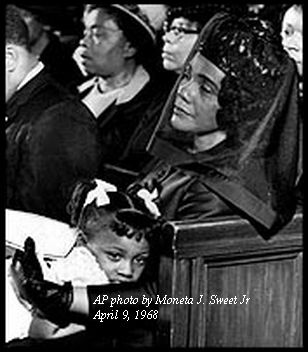
Coretta Scott King rests today in the bosom of Abraham. According to Andrew Young she passed quietly from this life to the next at about one o’clock this morning.

Her passing brought to mind the man and the cause she married. I remember her husband’s stirring words from1963, which were to become enshrined as the rhetorical anthem for the civil rights movement in America. I can still feel the tears running down my face as I heard the cry for justice:

I have a dream that one day this nation will rise up and live out the true meaning of its creed: “We hold these truths to be self-evident: that all men are created equal. ”I have a dream that one day on the red hills of Georgia the sons of former slaves and the sons of former slaveowners will be able to sit down together at a table of brotherhood. I have a dream that one day even the state of Mississippi, a desert state, sweltering with the heat of injustice and oppression, will be transformed into an oasis of freedom and justice. I have a dream that my four children will one day live in a nation where they will not be judged by the color of their skin but by the content of their character. I have a dream today.”

For her husband, the dream was cut short of its realization. For Coretta, the dream continued after his passing, too often deferred. The Divine call for justice too often gave way to the self-serving tenor of the times. Rocky ground, it seems, resists the Maker’s plow.

Through it all, Coretta was “steadfast, unmoveable, always abounding in the work of the Lord.” She was not a reed to be shaken in the wind. She had married a man and a cause. The man was taken, but the cause remained. It was that vision, more than anything else that united them. It was that vision that sustained her when he was taken.

At the most difficult of times she remembered that it was the Almighty who had energized them for the task and that their prayers would be answered. Knowing that, she was strengthened beyond measure:

“From that day on, I was fully prepared for my role as Martin's wife and partner in the struggle. There would be many more days of difficulty and worry, and there would be many more prayers. But the unwavering belief that we were doing God's work became a daily source of faith and courage that undergirded our freedom movement.”

So, today is a day of union and reunion for Martin and Coretta. They are united with the Author of the principles they embraced in this life. The peace and justice so often denied them in this life has been granted to them for all of eternity. And, Martin and Coretta have now been reunited with one another. They are resting in Abraham’s bosom.

There was something else that struck me today as I thought of the Kings and their lives of service now completed. They held fast to the principles they preached. They lived them. It’s a lesson we all would do well to re-learn today. We must do what is right and we must do it the right way:

“The whirlwinds of revolt will continue to shake the foundations of our nation until the bright day of justice emerges. But there is something that I must say to my people who stand on the warm threshold which leads into the palace of justice. In the process of gaining our rightful place we must not be guilty of wrongful deeds. Let us not seek to satisfy our thirst for freedom by drinking from the cup of bitterness and hatred.”

The earthly tasks God gave Martin and Coretta have been completed. We must now march on to complete the Divine tasks we’ve been given. As it has been proclaimed:

“With a good conscience our only sure reward, with history the final judge of our deeds, let us go forth to lead the land we love, asking His blessing and His help, but knowing that here on earth God's work must truly be our own.”

Technorati tags for this post:
Martin Luther King
Coretta Scott King

Monday, January 30, 2006

Sillibuster


Proverbs 10:23 (New Living Translation)

“Doing wrong is fun for a fool, while wise conduct is a pleasure to the wise.”

The cloture vote on the Samuel Alito nomination will take place this afternoon. It appears that there at least sixty two votes against the Democrats’ last ditch attempt to filibuster. We’ll see.

We should have seen this coming. Anyone desperate enough to engage in character assassination is desperate enough to insist they still have a chance to win the game. It’s like watching the quarterback of a football team that’s down sixty-three to nothing with ten seconds to go in the game heaving a Hail Mary pass.

John Kerry says that it’s all about principle:

“I am proud to join my friend, the senior Senator from Massachusetts, in taking a stand against this nomination. I know it is an uphill battle. I have heard many of my colleagues. I hear the arguments: Reserve your gunpowder for the future. What is the future if it changes so dramatically at this moment in time? What happens to those people who count on us to stand up and protect them now, not later, not at some future time?”

“This is the choice for the Court now. I reject those notions that there ought somehow be some political calculus about the future. This impact is going to be now. This choice is now. This ideological direction is defined now.”

Hillary Clinton has also thrown her support for a filibuster, again based on “principle”:

“Sen. Hillary Rodham Clinton said Friday she will support an effort to filibuster the Supreme Court nomination of Samuel Alito because she is concerned he will not do enough to protect American freedoms.” ”He would roll back decades of progress, and roll over when confronted with an administration too willing to play fast and loose with the rules,” Clinton, D-N.Y., said in a statement.”

Their supporters in the blogosphere seem to be every bit as desperate:

“The story of the day on Sunday Talk should have been just how close we are to extending debate. The story of the day should have been Alito confirmation in trouble. Two votes!”

“We have already flipped more than two to our side, we can get two more.”

“Instead we heard more of the same, “Alito” is a sure thing, nothing to see here. “Oh yeah and Kerry was in Switzerland, that was supposed to really matter and be very bad for some reason.”

Just a while ago there was this plea to Democrats who support the Alito nomination and oppose any attempt to filibuster it:

“Even those Democrats who have declared that they will vote for Alito should recognize that their Democratic colleagues, the majority of their party, feel the need to keep discussing this nomination. Is there really any reason for this debate not to continue? Does the vote happening on Wednesday or Thursday make that much difference compared to the enormity of a lifetime appointment to the highest court in the land?”

I’m trying to think of why some Democrats are doing this. Some say it’s all about principle. Really?

It’s nothing more than the politics of the absurd. It’s silly!

The Republican Party is vulnerable and the Democrats are acting like fools. It makes no sense. A move to filibuster Samuel Alito will serve only to placate the left wing of the Party and the folks at Daily Kos. The rest of us want more than silliness emanating from the well of the Senate. We’d like the kind of performance one should expect from an adult. Instead, we get the kind of politics that begins with character assassination and ends in political suicide.

In this morning’s Boston Globe Joan Vennochi noted:

“National security is the only drum left for Republicans to beat. But Karl Rove's scare tactics won't work forever. The country, collectively, is smarter than Bush's brain. It just needs time to think things through and an election day.”

“Bush's sometimes hesitant and awkward answers at press conferences can be scarier than another videotape from Osama bin Laden. But Democrats have yet to figure out the alternative voice the country wants to hear. What Democrats still know best is what the left wants to hear. Speaking to the liberal base in 2003, Kerry said: “I am prepared to filibuster, if necessary, any Supreme Court nominee who would turn back the clock on a woman's right to choose or the constitutional right to privacy, on civil rights and individual liberties, and on the laws protecting workers and the environment.”

“It was a bad pledge to make in the abstract, and it is the wrong pledge to live up to now. It defines fitness for nomination strictly in ideological terms. A Kerry Supreme Court nominee could be opposed by Republicans on the very same grounds. Sticking to it now, after Democrats failed so spectacularly during the Alito hearings, is pointless. Voting no on Alito is fine. But a filibuster serves no one but the Bush adminstration. It fuels the conservative base, helping to heal internal party splits.”

Don’t these folks understand what they’re doing? By pandering to the left wing they’re destroying any chance the Democratic Party has to connect with the American people. Maybe the fire-eaters like this sort of thing, but the rest of us don’t. This is not a nation that embraces the politics of the left anymore. Liberalism is dead. Can’t they see that? Apparently not!

One of the things this demonstrates to me is that the power to make appointments to the Court was wisely placed in the hands of the executive branch. Alexander Hamilton, in Federalist 76, warned of what might happen if the process was given to the Senate:

“There is nothing to apt to agitate the passions of mankind as personal considerations, whether they relate to ourselves or others, who are to be the objects of our choice or preference. Hence, in every exercise of the power of appointing to offices by an assembly of men we must expect to see a full display of all the private and party likings and dislikes, partialities and antipathies, attachments and animosities, which are felt by those who compose the assembly. The choice which may at any time happen to be made under such circumstances will of course be the result either of a victory gained by one party over the other, or of a compromise between the parties. In either case, the intrinsic merit of a candidate will be too often out of sight.”

In twenty-first century language it means that if the appointment process were controlled by the Senate it would little or nothing to do with the merits of a prospective candidate. It would be all about having agendas advanced or protected. In the twenty-first century it means Roe versus Wade.

That’s what this filibuster move is all about. It’s not about principle. It’s about agenda driven by the far left. As I said before, it may play well to the folks at Daily Kos. But, for the rest of us, both Republican and Democrat, it’s nothing more than silliness draped in expensive suits.

Technorati tags for this post:

Sunday, January 29, 2006

Sunday Morning Questions for the Pilgrim and the Skeptic


Psalm 8:3-5 (King James Version)

“3When I consider thy heavens, the work of thy fingers, the moon and the stars, which thou hast ordained;
4What is man, that thou art mindful of him? and the son of man, that thou visitest him?
5For thou hast made him a little lower than the angels, and hast crowned him with glory and honour.”

I read a short devotional piece from Frederick Buechner’s “Listening to Your Life” this morning. It was titled, appropriately, “Questions.” It follows, now, for your edification, especially those of you reading who might be skeptics:

“On her deathbed, Gertrude Stein is said to have asked, “What is the answer?” Then, after a long silence, “What is the question?” Don’t start looking at the Bible for the answers it gives. Start by listening for the questions it asks.”

“We are much involved, all of us, with questions about things that matter a good deal today but will be forgotten by this time tomorrow – the immediate where and whens and hows that face us daily at home an at work – but at the same time we tend to lose track of the questions of the things that matter always, life-and-death questions about meaning, purpose, and value. To lose track of such deep questions as these is to risk losing track of who we really are in our own depths and where we are really going. There is perhaps no stronger reason for reading the Bible than that somewhere among all those India-paper pages there awaits each reader whoever he is the one question which, though for years he may have been pretending not to hear it, is the central question of his own life. Here are a few of them”:

“What is man profited if he shall gain the whole world and lose his own soul? (
Matthew 16:26)”
“Am I my brother’s keeper? (
Genesis 4:9)”
“If God is for us, who can be against us? (
Romans 8:31)”
“What is truth?” (
John 18:38)”
“How can a man be born again when he is old? (
John 3:4)”
“What does a man gain by all the toil at which he toils under the sun? (
Ecclesiastes 1:3)”
“Whither shall I go from thy Spirit? (
Psalm 139:7)”
“Who is my neighbor? (
Luke 10:29)”
“What shall I do to inherit eternal life? (
Luke 10:25)”

“When you hear the question that is your question, then you have already begun to hear much. Whether you can accept the Bible’s answer or not, you have reached the point where at least you can begin to hear it too.”


I began this post with questions the psalmist asked. What is man? And, why would God even want to have anything to do with him? They’re good questions and they have good answers. They can be found in the Bible.

I’m sure you have questions. Ask them. As it’s written, “Ask and it shall be given you; seek and you shall find.”

Technorati tags for this post: